Table of Contents
- What Makes the Flippant Change Worth Learning
- What You Will Learn
- Step-by-Step Breakdown
- Key Tips and Common Mistakes
- Practice Advice
-
Bonus Application: Visual Card Production
- Final Takeaway
What Makes the Flippant Change Worth Learning
Most color changes need two hands. The Flippant Change only needs one hand, a small pinky break, and good timing. When the timing is right, the change looks instant and completely effortless.
Created by Looy Simonoff, this move is deceptively simple. The mechanics are minimal, but the visual payoff is big. Here is everything you need to perform it cleanly, plus a bonus application that turns the same move into a visual card production.
What You Will Learn
- The full handling of the Flippant Change, step by step
- How to obtain the break and manage air gaps
- Timing and cover tips that make the change look instant
- Common mistakes and how to fix them
- A bonus use: producing four Aces (or any packet) visually
Step-by-Step Breakdown
Step 1: Display the Card and Set the Break

- Remove the card you want to change and show it to the audience.
- While displaying it, push the top card of the deck slightly sideways with your thumb, then pull it back to catch a small pinky break beneath it.
- This break creates the air pocket that makes the flip possible. Once it is secure, you are ready.
Step 2: Place the Card and Remove Any Trapped Air Pockets

- Flip the displayed card face up on top of the deck.
- Keeping the pinky break, give the top of the deck a brief tap or press down. This removes any extra air between the two top cards and helps prevent the cards from separating during the flip.
Step 3: The Drop
This is where the change happens.
- Start from a steady, relaxed position. Do not lift up first.
- Drop your hand suddenly, a short distance downward.
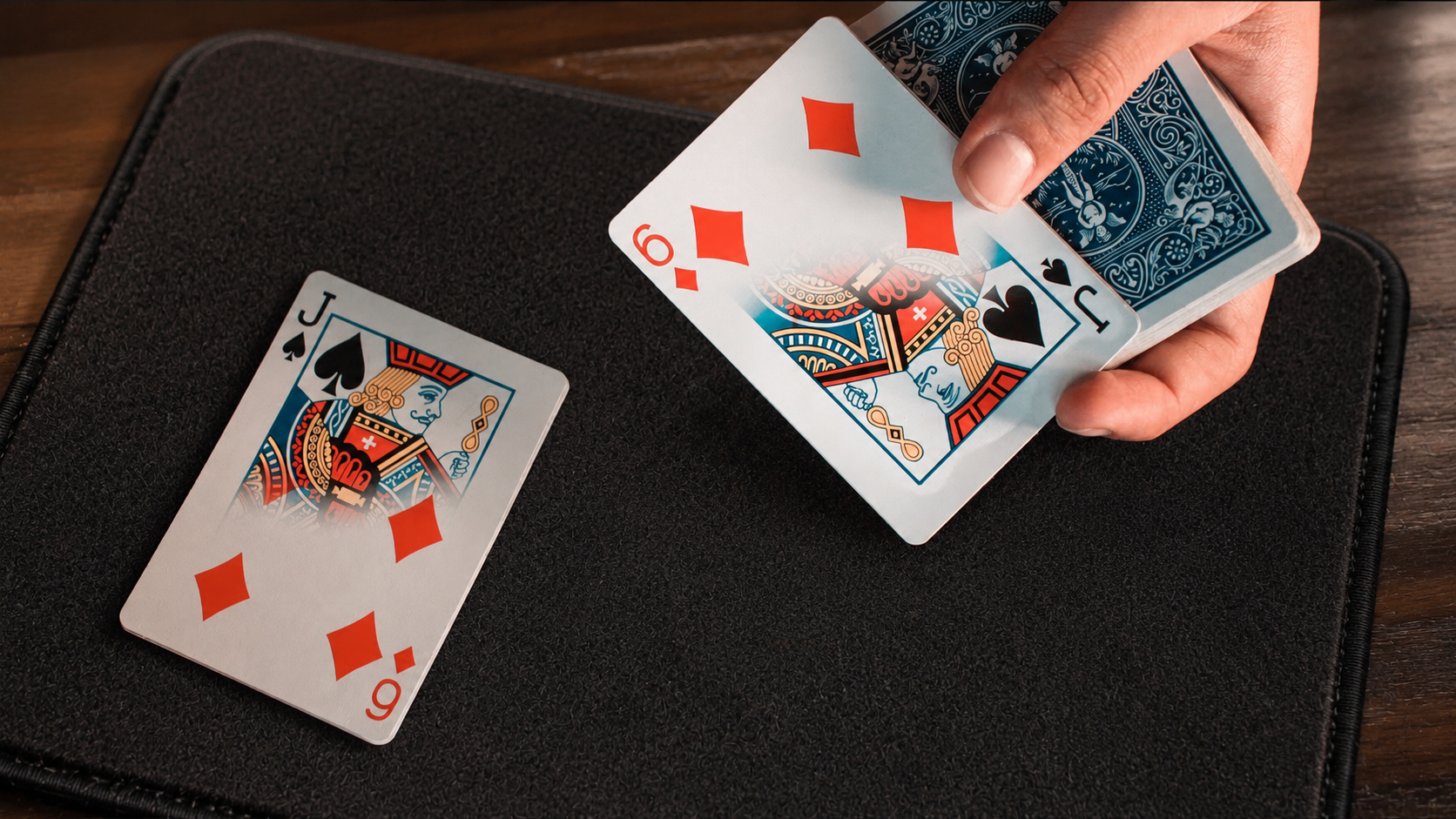
- Air enters the break, and the top two cards flip over together, landing back on the deck.
Done at speed, it looks like the card changed on its own. The left edge of the card contacts your thumb during the flip, acting as a natural pivot point that helps the cards turn over cleanly.
Step 4: Square Up
After the flip, square the deck casually as part of the same motion. Do not treat squaring as a separate, noticeable action. If you are using cover (see below), the squaring becomes invisible.
Key Tips and Common Mistakes
Timing Is Everything
The Flippant Change lives and dies on timing. The method is simple, but if the drop happens too early or too late relative to your cover, the illusion breaks.
Do Not Go Up Then Down
This is the most common beginner mistake. Lifting your hand upward before dropping is a huge tell. Instead, start from a steady position and drop suddenly. The audience should never see an "upswing" before the change.
Keep the Drop Small
Ideally, you only need to drop about the width of a card. Beginners will drop farther at first, and that is fine. Over time, focus on reducing the motion until it feels tight and effortless.
Use Cover to Make It Look Impossible

While the Flippant Change can technically be done one-handed, it often looks best with a touch of natural cover. Bring your other hand over the deck briefly, not to do the move, but to create shade. As soon as your hand covers the top of the deck, perform the drop. Done well, the audience sees nothing but an instant, visual change.
This covering approach is credited to Greg Wilson, and it turns a good move into a performance-ready one.
Practice Advice
Expect the Flippant Change to feel awkward at first. The motion is not complicated, but it is unfamiliar.
- Start slow. Get the cards to flip reliably before worrying about speed.
- Practice in front of a mirror. Watch for awkward finger tension and moments where the cards may split in the air and not square up.
- Then work on making the action smaller and faster, until the change reads as instant.
This is a "trial and error" move. You will find the sweet spot through repetition.
Bonus Application: Visual Card Production

The Flippant Change is not only a color change. You can use the same mechanics to visually produce cards.
Here is a practical example:
- Start with four Aces on top of the deck.
- Hold a pinky break beneath the packet.
- Perform the Flippant Change motion as normal.
- The Aces flip into view as a sudden, visual moment.
Instead of just pulling out the Aces for a four-Ace routine, you introduce them with a visual hit. It is a small addition that makes the opening of the trick feel more polished.
Final Takeaway
The Flippant Change is one of those moves where the effort-to-impact ratio is in your favor. The mechanics are simple. The real skill is in the timing, the cover, and the confidence to make the drop sudden and small. Once those pieces click, you have a one-handed color change that looks effortless and a card production that adds a visual punch to any routine.
If you want to keep learning, the 52Kards free video library has hundreds of tutorials sorted by difficulty and type.